Every cold campaign I run lives or dies on one thing: who I send it to.
Get the Ideal Customer Profile right, and reply rates climb, sales cycles shorten, and the feedback I get back is useful instead of polite. Get it wrong, and the best copy in the world lands in the wrong inbox.
The pattern is consistent. Campaigns built on a clear ICP see reply rates roughly 52% higher than generic blasts, and about 71% of decision-makers skip any email that never touches their real problem.
Here is what changed by 2026: a static ICP written once and saved to a doc quietly rots. People move companies, businesses raise money, org charts shift, and last quarter's perfect list becomes this quarter's bounce pile.
This guide covers what an ICP is, why the fixed version breaks, how to build one from data I already have, and how to turn it into a living list that keeps itself current.
An ICP is the blueprint of the businesses most likely to become your best customers, and it tells every downstream decision who to chase and who to skip.
These two tools solve different problems, and mixing them up costs replies.
For B2B outreach, the ICP decides which accounts deserve attention. The persona decides how the message reads once you are in front of the right person. I need both, but the ICP comes first.
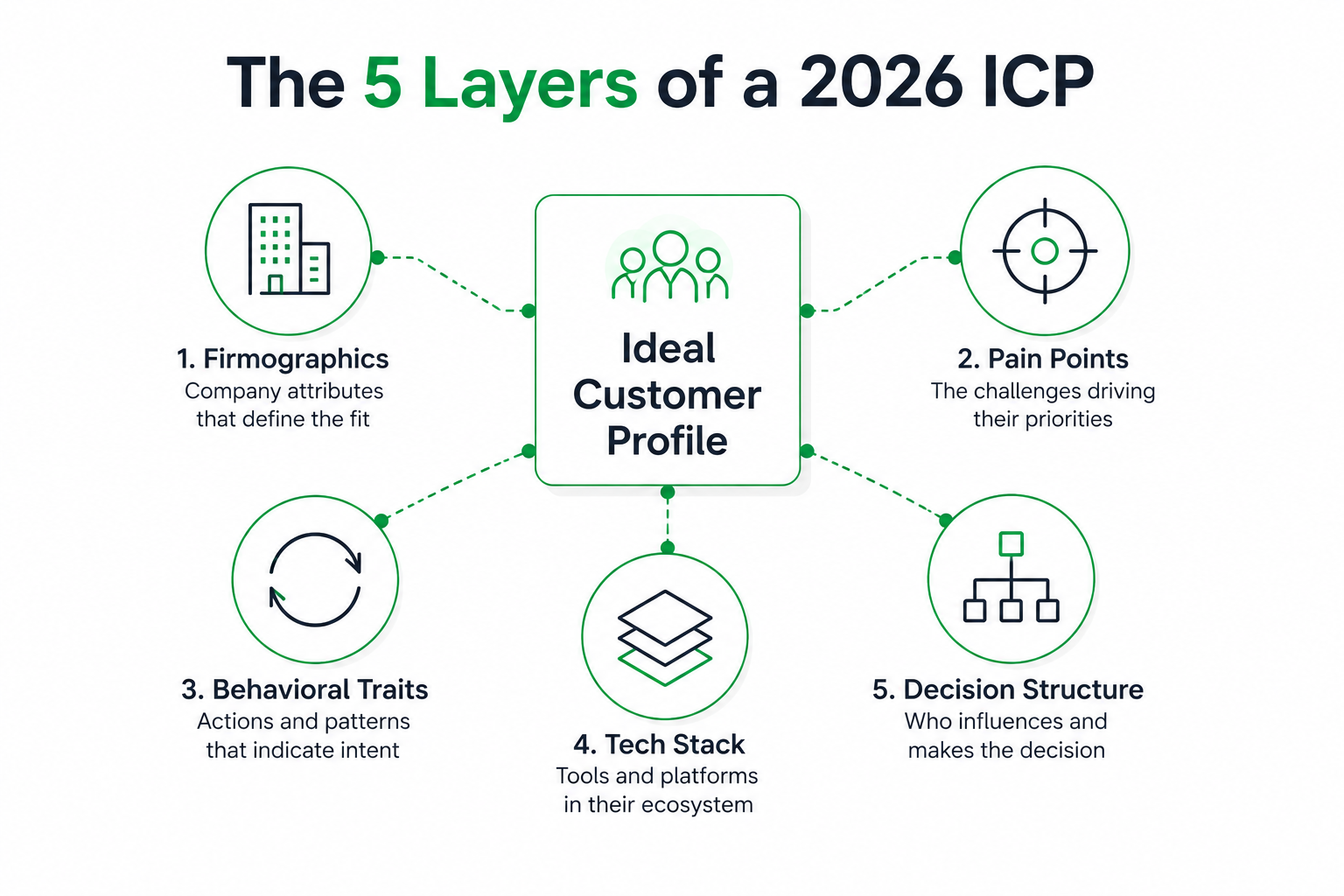
A profile that actually improves targeting is built from five layers, not one.
A profile saved once and never touched looks precise on paper while quietly going stale, and in 2026, the decay is fast enough to sink a whole campaign.
A cold list ages the moment it is built. Contacts change roles, companies restructure, and champions leave. When the person I researched has moved on, my carefully personalized email reaches a stranger who never had the problem I am solving.
This is the part most guides skip. The ICP was right. The list built from it went out of date. The campaign still failed. When an entire quarter of outreach rides on one frozen snapshot of the market, small amounts of rot compound into flat reply rates and rising bounces.
The shift I made in 2026 was to stop treating the ICP as a filter I run once and start treating it as a trigger that fires when an account enters a buying window.
A firmographic match tells me an account could be a fit. A signal tells me it is a fit right now. A company that just raised a round has a budget it did not have last month. A prospect who just started a new role is rebuilding their stack. Same ICP, far better timing.
This is also where audience work pays off. Pairing a sharp ICP with tighter B2B audience segmentation keeps each segment small enough to write to and specific enough to trigger on.
The strongest ICP is reverse-engineered from the customers who already love you, then pressure-tested against the wider market.
I start with the accounts that get the most value: the ones who renew, refer, and expand. I sort customers into best, good, and poor fit, then look at what the best-fit group has in common across size, industry, and revenue.
I pay closest attention to lifetime value and profitability, and I read the closed-won deals for the sources and actions that led to them. I also read the losses. Knowing why a bad-fit account failed keeps the wrong traits out of the profile.
Data gives me the what. Interviews give me the why. Three questions do most of the work: what was breaking before they bought, how the product changed that, and how they found me in the first place.
When the same challenge surfaces across several conversations, it becomes a cornerstone of the profile. The surprises matter too, because an unexpected use case often points to a segment I had not considered.
Internal data can trap me inside my current customer base. Market research widens the view. I read my own website analytics for demand, my sales numbers have not caught up to yet, and I check industry benchmarks to confirm a promising segment is growing rather than shrinking.
Most revenue teams now revisit their ICP as the market moves rather than once a year, and that habit is the difference between a profile that ages well and one that quietly expires.
Once the profile is written, I hand it to Leadsforge, which converts a paragraph of intent into a matching, enriched list and keeps it current with real-world events.
Instead of stacking filters, I describe the ICP in a sentence and get a list back. Leadsforge searches a database of 500M+ contacts, then runs waterfall enrichment, querying multiple data providers in sequence to fill in emails and phone numbers at the highest coverage and confidence.
For prospecting straight from a profile or a search, the LinkedIn email and phone finder Chrome Extension, powered by Leadsforge, pulls verified contact details without leaving the tab. New users get 100 free credits on signup.
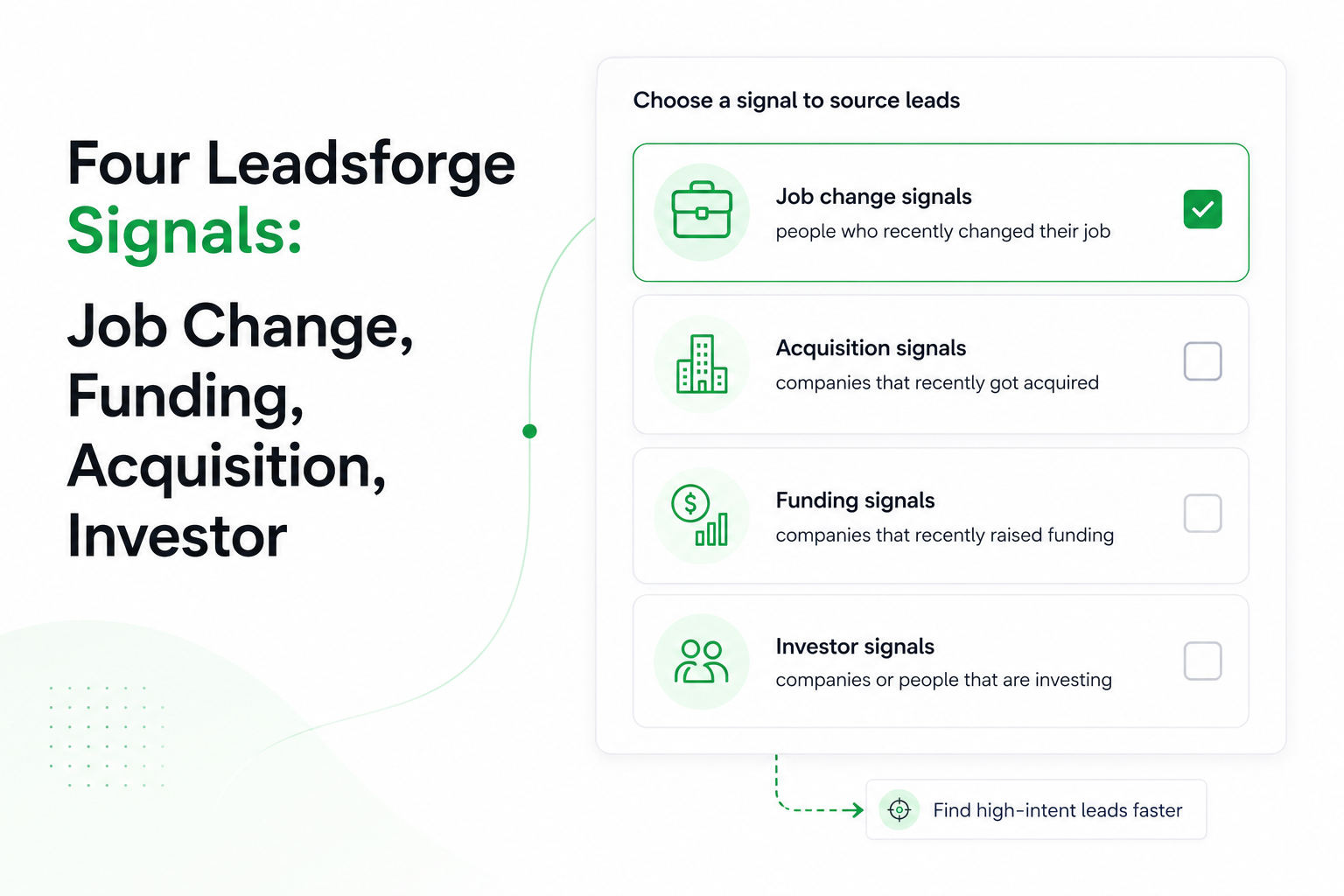
Signals is a newer sourcing path in Leadsforge that builds lists around companies and people who just did something meaningful, so timing stops being a guess. There are four signal types, each filterable down to the accounts actually in-market.
For company-based signals, Leadsforge first identifies the matching companies, then matches them against the contact database and surfaces the relevant employees. I get to the right person at the right account, not just the account.
Every extracted company and contact carries supporting evidence. Opening the details view shows exactly why a match fired, drawn from public sources. That transparency means I can write a first line that references the actual trigger instead of pretending to know something I do not.
A live list is only half the job. The ICP also shapes every word once Salesforge starts sending across email and LinkedIn in one sequence.
The ICP is a goldmine for subject lines. A line built on a specific pain point signals relevance instantly, which matters when a third of people open on the subject line alone. Firmographics fine-tune the angle, and behavioral traits set the tone and urgency.
The body follows the same logic. A CFO wants ROI and cost. A CTO wants integration and technical fit. Salesforge personalizes copy at scale using AI variables that pull company news, LinkedIn activity, and industry context, with native fluency across 21+ languages, so localized campaigns run without a copywriter per region.
Proof lands hardest when it mirrors the prospect. A 150-person agency cares about a result from a similar agency, not a Fortune 500 case study. The ICP tells me which story to attach, and the signal tells me which moment to attach it to.
The same profile drives the email touch and the LinkedIn touch inside a single conditional sequence. Replies from both channels land in Primebox, the unified inbox, where Co-Pilot drafts responses for approval, and Auto-Pilot carries routine threads forward. If you want the full framework, my guide on how to write a cold email pairs well with this.
A perfect list still fails if the emails land in spam, so the ICP only pays off when the sending foundation underneath it is healthy.
Salesforge warms every connected mailbox for free through Warmforge, tracks a Heat Score for each one, and matches sender to recipient by ESP so Google talks to Google and Microsoft talks to Microsoft. Bounce Shield pauses any mailbox that crosses a bounce threshold before the damage spreads, and sender rotation spreads volume so no single inbox burns out.
The list I source has to reach a healthy inbox to matter. Choosing the right email infrastructure (shared, dedicated, or provider-native mailboxes) under one login means the deliverability layer scales with the ICP instead of fighting it.
The campaign data is the honest referee, telling me whether the profile matches reality or needs a rewrite.
A handful of numbers reveal whether the ICP is on target.
The ICP is not set and forget. I A/B test attributes, running one segment against another, and I review the numbers monthly. Which job titles reply most? Which company sizes convert? The combinations that win get more budget, and the ones that stall get cut.
I also connect email results back to closed deals, because the segments that reply are not always the segments that buy. Feeding that back into the profile and letting Agent Frank prospect continuously against the refined criteria turns the ICP into a loop that improves itself.
The reason a signal-driven ICP is practical in 2026 is that discovery, deliverability, and sending sit under one roof instead of across four vendors.
Lists move from Leadsforge straight into Salesforge sequences with no CSV export. Warmforge warms the mailboxes, the infrastructure products supply them, and Primebox unifies every reply. No competitor bundles the lead finder, the warmup, the infrastructure, the outreach, and an autonomous AI SDR as one connected stack.
That same stack runs three ways, which is the part that fits different teams. My own team can operate it hands-on. Agent Frank can run the entire workflow end to end, prospecting from the ICP, sequencing, replying, and booking meetings 24/7. Or a Forge Expert agency can run it on my behalf. The ICP stays the same. Only the operator changes.
The ICP did not stop mattering in 2026. It stopped being a document.
Five years ago, a firmographic profile saved to a slide was enough, because lists moved slowly and a snapshot held up for a quarter. Today the accounts that reply are the ones caught inside a live window: fresh funding, a new decision-maker, a recent acquisition. A static profile misses those windows by design.
So the work splits into two. Define the profile with rigor, from best-fit customers, interviews, and market validation. Then make it live, so the list reacts to signals instead of aging in a spreadsheet. Source it, enrich it, warm the mailboxes, and let the same ICP drive email and LinkedIn in one sequence.
That is the whole motion, and it runs in one place. Start with a sharp ICP and a live list, and the rest of the campaign stops being a gamble.
What is an Ideal Customer Profile (ICP)?
An ICP is a description of the companies most likely to become high-value customers, built from firmographics, pain points, behavioral traits, tech stack, and decision-making structure. It defines which accounts to target so outreach stays relevant rather than generic.
What is the difference between an ICP and a buyer persona?
The ICP describes the company that is the right fit. The buyer persona describes the individual decision-maker inside that company. The ICP decides which accounts to pursue, and the persona shapes how the message reads once you reach the right person.
How do I build an ICP with limited customer data?
Start with qualitative insight. Interview your most engaged prospects and best customers about their challenges and goals, then use market research and industry reports to spot shared traits like size, industry, and location. That gives you a working profile you refine as more data arrives.
Why do static ICPs stop working?
Because the market moves. Contacts change jobs, companies restructure, and champions leave, so a list built from a frozen profile ages into bounces and dead threads. A signal-driven ICP that reacts to job changes, funding, acquisitions, and investment activity keeps the list current.
What are Leadsforge Signals?
Signals is a sourcing path in Leadsforge that builds lists around real-world events. The four types are Job Change, Funding, Acquisition, and Investor, each filterable by criteria like location, industry, size, and role. Every match includes evidence from public sources explaining why it fired.
How often should I update my ICP?
Revisit the core profile every three to six months, and any time your strategy, pricing, or market shifts. With a signal-driven list, the day-to-day freshness is handled automatically because the list reacts to events as they happen.
Which metrics tell me my ICP is right?
Watch open rate (aim for 60%+), reply rate (20%+ is top quartile), positive reply rate (50%+), and bounce rate (under 3 to 5%). Low reply rates usually mean the ICP and the message are misaligned. High bounces usually mean the data behind the ICP needs cleaning.